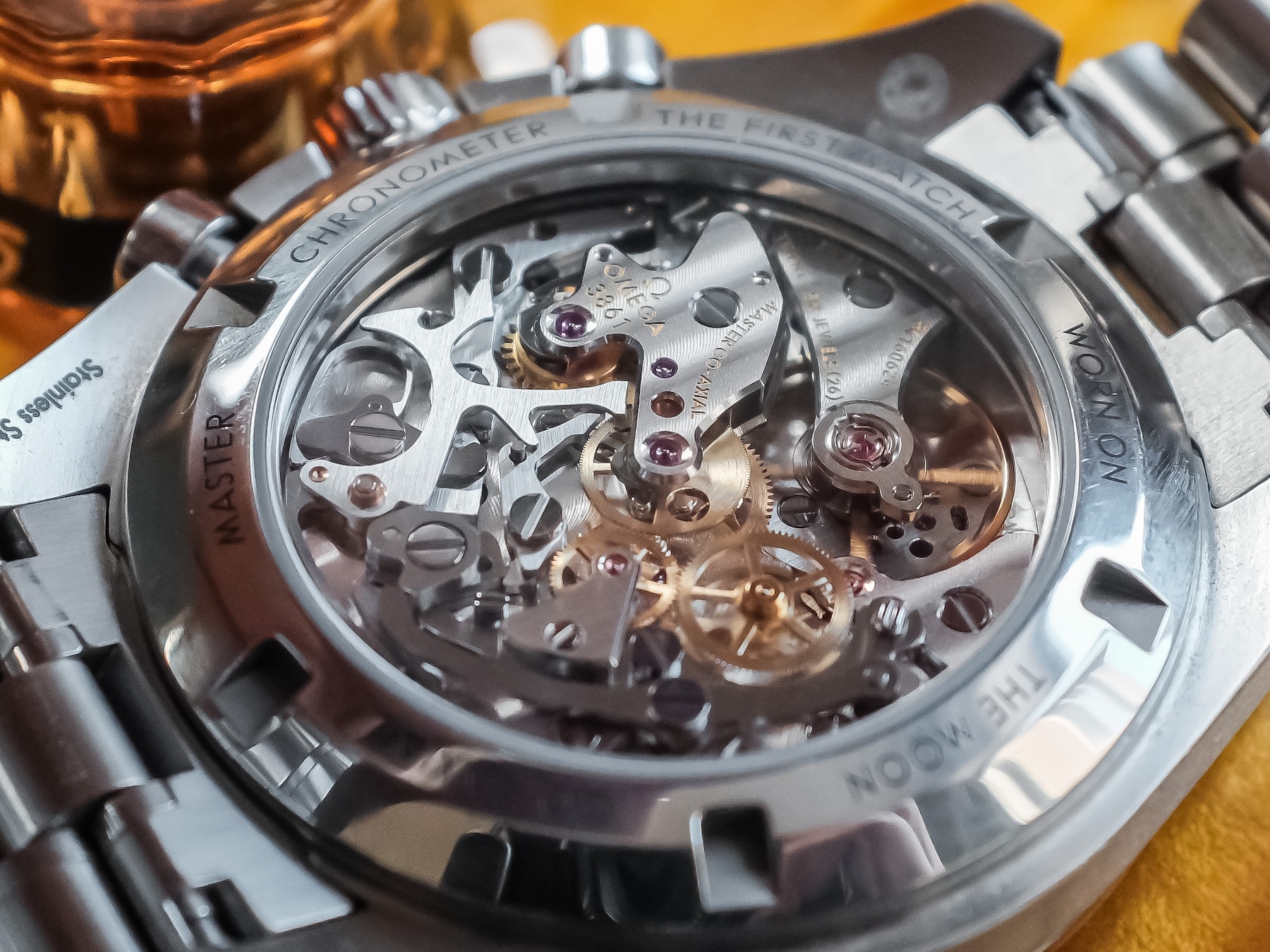
A mechanical watch stores energy in a wound mainspring; the spring drives a gear train through an escapement that meters out impulses to a balance wheel oscillating at 3-5 Hz. The mechanism is a 200-year refinement of 18th-century pocket-watch engineering; modern Swiss mechanical movements deliver 5-10 seconds per day rate accuracy with proper regulation, and ±2 seconds per day for top-tier Superlative Chronometer Rolex.
A quartz watch uses a tuning-fork-cut quartz crystal at 32,768 Hz; the resonance is divided down by an integrated circuit to 1 Hz and drives a step motor that ticks the seconds hand once per second. The mechanism dates to the 1969 Seiko Astron launch; modern quartz movements achieve ±15 seconds per month (3-5× more accurate than the best mechanical), run on a single battery for 1-3 years, and cost an order of magnitude less than equivalent mechanicals to manufacture.
"Quartz wins on every measurable metric. Mechanical wins on every unmeasurable one."- Watch industry observation
The practical difference for owners: a mechanical watch needs winding (manual every 1-2 days, or wrist motion for automatic) and servicing every 5-10 years at 10-30% of retail cost; a quartz watch needs a battery change every 1-3 years and essentially nothing else for decades. Mechanical accuracy drifts seconds per day; quartz drifts seconds per month. For pure timekeeping function, quartz is better in every measurable way.
The cultural difference is the entire reason the mechanical industry survived the quartz crisis. Mechanical watches embody 200 years of craft tradition: hand-finishing, complications, the visible engineering that animates the balance wheel; they are worn for what they represent, not what they functionally do. The watch industry today is bifurcated: quartz dominates volume (>95% of watches sold) at the entry tier; mechanical dominates value (>70% of revenue) above CHF 1,000.
High-end quartz exists as a niche: the Seiko / Grand Seiko Spring Drive hybrid (mechanical drive + quartz regulation), the Citizen Caliber 0100 (±1 second/year, the most accurate consumer wristwatch ever made), and various Bulova and Breitling Superquartz references. Hybrid categories like Spring Drive deliberately combine mechanical aesthetic (gliding seconds, mainspring drive) with quartz precision; these sit in a small but distinctive premium segment.
For buyers, the practical guide: quartz is the right choice for a daily-utility watch where accuracy matters and maintenance time is minimal; mechanical is the right choice for a watch worn as cultural object, family heirloom, or piece of horological craft. The two are not competing answers to the same question; they are answers to different questions.
Comments 1